_edited.jpg)


Cursing Fruitless Faith: Jesus and the Fig Tree
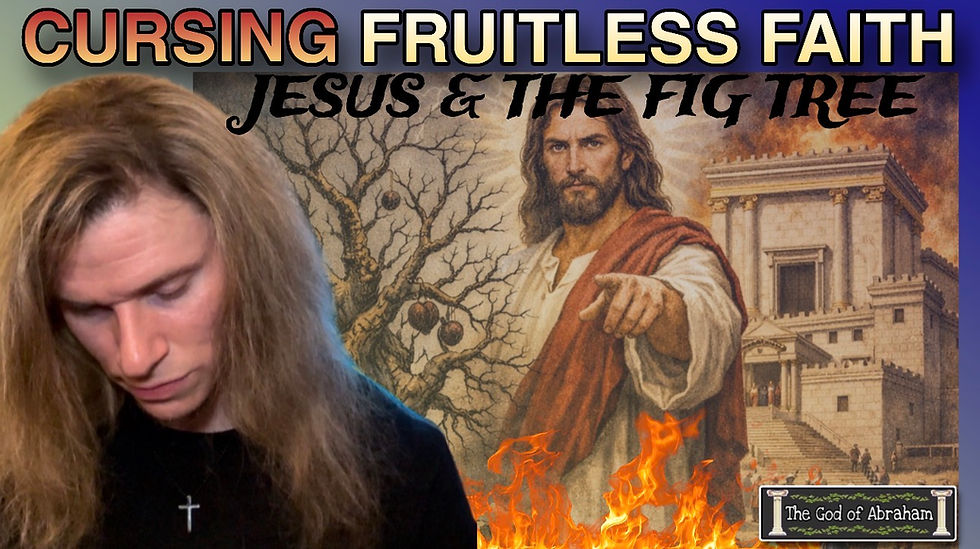
There is a peculiar story in Mark’s Gospel that often raises more questions than it answers. Jesus comes across a fig tree when he’s hungry, and because the tree has no fruit, he curses it. This despite the fact that we read, it was “not the season for figs.” So, upon first reading, the question is raised: why does Jesus get mad at a fig tree that doesn’t produce fruit out of season; this seems demanding, even illogical. (But remember: “God chose the foolish things of the world to shame the wise” – 1 Cor. 1:27) To better understand the story, we need to step back for a moment and look at the full context of the passage.
Mark tells us that Jesus entered Jerusalem, and visited the Temple. That evening, he and his apostles went to Bethany. The next morning, on the way back to Jerusalem, Jesus saw a leafy fig tree. Hungry, he approached it, only to discover that it offered nothing to eat. As we already said, the fig tree was out of season, what was he expecting? Well, here is the key detail: A healthy fig tree produces small edible nodules called “pagim,” which appear even before the leaves come in. The issue with the leafy fig tree in the passage is that it bore absolutely nothing to eat despite its appearance otherwise. Simply put, the tree is falsely advertising fruit by showing off its leaves. Or another way to put it, it is pretending to be something it’s not. In this way, the fig tree represents hypocrisy – and that is what Jesus is cursing.
This seamlessly brings us to what the fig tree had always represented to people in Jesus’ day – it represented Israel. The prophets Jeremiah, Hosea, and Micah all used this metaphor. A barren fig tree represents Israel – a people who display the outward signs of religious life but with none of its fruits.
This metaphor becomes even more apparent when we place Jesus’ cursing of the fig tree in its appropriate context. Notice, Jesus begins in the Temple. Then he comes across the fig tree and curses it for its hypocrisy. The next thing we read is how Jesus went back to the Temple, and drove out the moneychangers – which is to say, he drove out the hypocrites. And after that, he leaves the city once more, and again he comes across the fig tree. And Peter says, “Master, behold, the fig tree which thou cursed is withered away.”

Mark is showing us how the Temple is tantamount to the leafy fig tree – they are both outwardly impressive but inwardly barren. Furthermore, both the Temple and the fig tree represent Israel – the people God has rejected because they bear no fruit - Jesus cursed them both.
What is more, despite my earlier explanation of the pagim, critics still argue that the fig tree was “out of season” so the parable doesn’t work; it just makes Jesus look like a demanding bully. Let us look at something else Jesus says to help explain away this confusion. Jesus tells his apostles that he chooses them because they “are not of the world.” (John 15:19). In this respect, to be “out of season” is to challenge the world’s time frame. When the world says ‘now is not the time… to be holy, or to be faithful, or to be followers of Christ’ it is up to us to bear fruit, so to speak, in spite of this. As Paul said to Timothy, Jesus expects fruit ‘in season and out of season.’ We go by God’s timing, not the World’s.
So, the lesson is this: if we don’t want to be cursed and wither away, then we must bear the fruit that God seeks - regardless of the world’s limitations, constraints, and demands. The Lord’s hunger is not satisfied by empty religious gestures, but by the real fruits of faith.
RELATED VIDEO:


Comments